
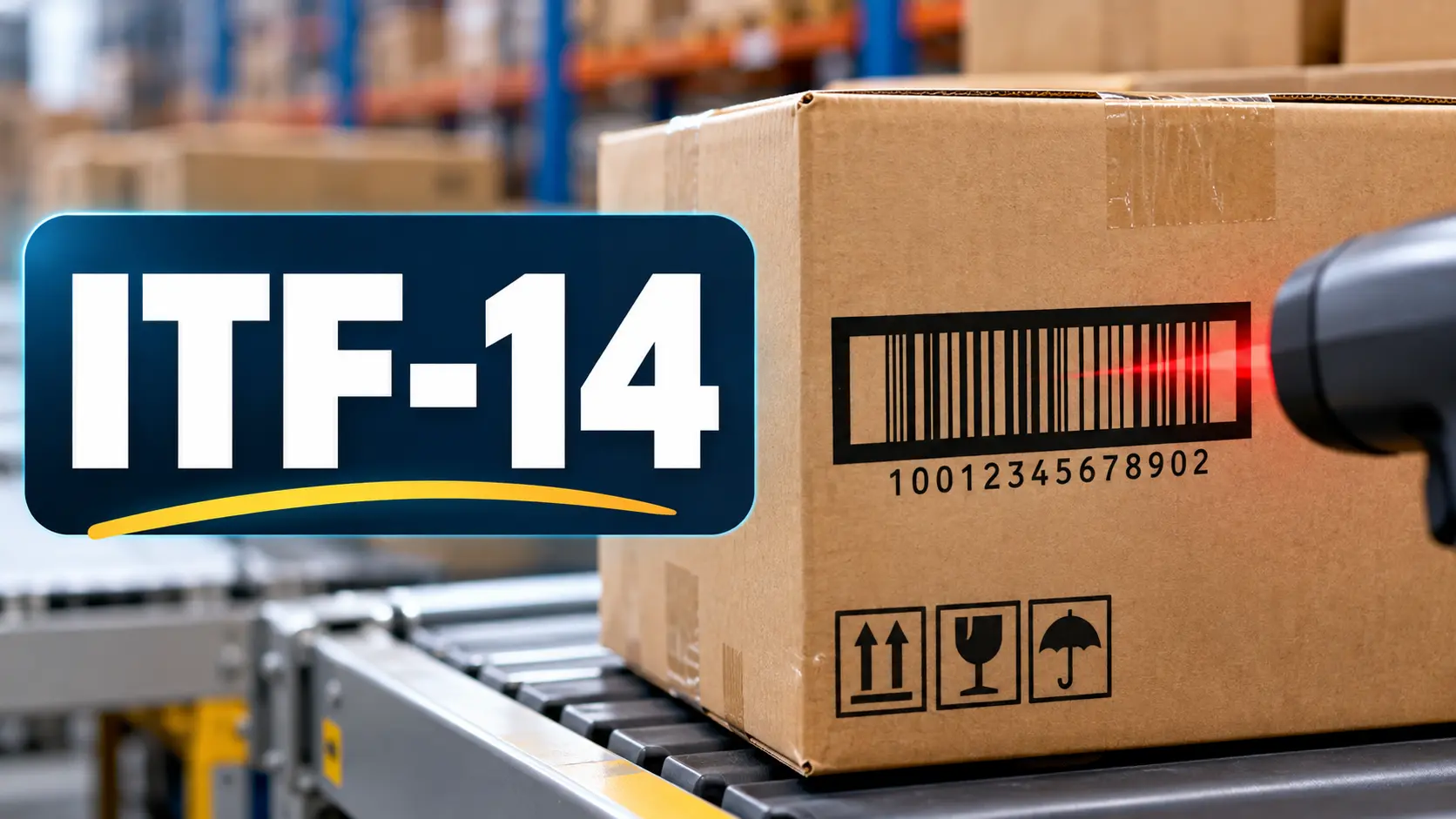
An ITF-14 barcode is a 1D barcode mainly used to identify cartons, cases and other trade-item groupings that move through warehouses and distribution systems rather than retail checkout lanes. It encodes a GTIN in a 14-digit representation and is especially well suited to packaging such as corrugated cardboard.
You may see ITF-14 on a box containing several identical retail products, even though each individual product inside has its own UPC or EAN barcode. The barcode on the carton helps businesses identify and scan the larger packaging level without opening the case or scanning every item individually.
The most important distinction to understand is simple: ITF-14 is the barcode symbol, while a GTIN is the identification number carried by the barcode. ITF-14 and GTIN-14 are therefore closely related but they are not two names for exactly the same thing.
What Does ITF-14 Mean?
ITF stands for Interleaved Two of Five, sometimes written as Interleaved 2 of 5. The “14” refers to the 14-digit representation used by the GS1 implementation of the barcode.
ITF-14 belongs to the family of one-dimensional barcodes. A scanner reads patterns formed by narrow and wide bars and spaces, rather than the two-dimensional arrangement of squares found in codes such as QR Code or Data Matrix.
The word “interleaved” describes how numbers are encoded in pairs. One digit is represented by bars while the other digit in the pair is represented through the spaces between them, allowing numeric information to be stored efficiently.
What Is an ITF-14 Barcode Used For?
ITF-14 is primarily used for trade items that are not intended to pass through a retail point-of-sale checkout. Common examples include cases, cartons and other fixed product groupings handled during shipping, receiving, inventory management and warehouse distribution.
Imagine a company sells bottles of juice individually. Each bottle may carry a retail UPC or EAN barcode, while a corrugated case containing 24 bottles may have its own identifier represented in an ITF-14 barcode.
When that case arrives at a warehouse, an employee can scan the carton itself rather than scanning all 24 bottles. The warehouse system can then recognise exactly which trade-item grouping has been received.
This is one reason ITF-14 is commonly associated with outer packaging rather than individual consumer products.
Why Is ITF-14 Common on Corrugated Boxes?
Corrugated cardboard is not as smooth or predictable as a high-quality product label. Printing very fine barcode elements directly onto cardboard can therefore be more challenging.
ITF-14 uses comparatively simple and robust bar patterns that work well in distribution environments and with printing methods commonly used for corrugated packaging. The barcode can tolerate the practical realities of case printing better than some barcode formats designed primarily for retail labels.
That does not mean an ITF-14 barcode can be printed carelessly. Correct size, contrast, quiet zones, bar height, placement and print quality are still essential for reliable scanning.
If you regularly prepare barcode artwork for packaging, our guide to common barcode printing mistakes explains several problems that can make an otherwise correct barcode difficult or impossible to scan.
ITF-14 vs GTIN-14 Difference
This is where many barcode explanations become confusing.
A GTIN, or Global Trade Item Number, is an identifier used for a trade item. GTINs can exist in different lengths, including GTIN-8, GTIN-12, GTIN-13 and GTIN-14.
An ITF-14 barcode is a data carrier that represents a GTIN using a 14-digit field.
For example, an actual GTIN-14 can be encoded directly in an ITF-14 barcode. A shorter GTIN, such as a GTIN-12 or GTIN-13, can also be represented in ITF-14 by adding the required leading zeros so that the encoded representation contains 14 digits.
Adding those zeros does not create a new product identifier. It simply allows the existing shorter GTIN to be represented within the 14-digit field required by ITF-14.
So the easiest way to remember the difference is:
| Term | What it is |
|---|---|
| GTIN | A trade-item identification number |
| GTIN-14 | A GTIN containing 14 digits |
| ITF-14 | A barcode symbology that encodes a GTIN in a 14-digit representation |
This distinction becomes especially important when working with product packaging, because assigning a new GTIN-14 to a case is different from merely adding leading zeros to an existing GTIN for barcode representation.
What Does an ITF-14 Barcode Look Like?
An ITF-14 barcode usually appears wider and heavier than the UPC or EAN barcode found on a typical retail product. It contains alternating black bars and white spaces, human-readable digits below the symbol, clear spaces on both sides and distinctive thick lines known as bearer bars.
A complete ITF-14 symbol includes several functional parts:
| ITF-14 element | Purpose |
|---|---|
| Left quiet zone | Clear area before the barcode begins |
| Start pattern | Tells the scanner where encoded data starts |
| Encoded characters | Carry the 14-digit GTIN representation |
| Stop pattern | Marks the end of the encoded symbol |
| Right quiet zone | Clear area after the barcode ends |
| Bearer bars | Support printing and scanning reliability |
| Human-readable digits | Allow people to read or manually enter the number |
These elements should not be treated as optional graphic details. Changing or cropping them can affect whether scanners can read the symbol correctly.
What Are Bearer Bars on ITF-14?
The thick black lines around or alongside an ITF-14 barcode are called bearer bars. They are one of the most recognisable features of this barcode type.
Bearer bars were designed to help control printing problems and reduce the risk of partial or incomplete scans. Their exact appearance can depend on the printing process used.
On some ITF-14 symbols, the bearer bars form a rectangular frame around the barcode. With other printing methods, they may appear primarily across the top and bottom.
This means an ITF-14 barcode does not always have to look visually identical to every other ITF-14 symbol you find online.
What Are ITF-14 Quiet Zones?
The blank areas immediately before and after an ITF-14 barcode are called quiet zones. They provide the scanner with empty space so it can distinguish the beginning and end of the barcode from nearby text, borders or packaging graphics.
Quiet zones are compulsory. Under the GS1 specification, the minimum quiet zone on each side is 10 times the X-dimension, where the X-dimension is the width of the narrow barcode element.
This is why placing text, a logo, packaging artwork or another line too close to an ITF-14 barcode can create scanning problems even when the bars themselves are correctly generated.
A barcode should therefore never be cropped tightly just because the empty area appears unnecessary.
How Are the 14 Digits Used?
The meaning of the digits depends on the GTIN being represented.
When a company assigns an actual GTIN-14 to a trade-item grouping, the number can include an indicator digit at the beginning, the identifying digits associated with the trade item and a check digit at the end.
For suitable fixed-measure groupings, indicator values from 1 through 8 can be used when creating different GTIN-14 identifiers for packaging configurations. However, the indicator digit does not automatically mean “case,” “box,” “12-pack” or another universal packaging level.
A company could, for example, assign one GTIN-14 to a carton containing 12 units and another GTIN-14 to a different fixed grouping. The company's product and inventory records determine what each identifier represents.
That explanation applies to an assigned GTIN-14. If a shorter GTIN is simply being represented in an ITF-14 symbol using leading zeros, those leading zeros should not be mistaken for packaging indicator digits.
Does ITF-14 Have a Check Digit?
Yes. The last digit of the GTIN represented in ITF-14 is a check digit.
The check digit is calculated mathematically from the preceding digits. It does not identify the product, case quantity or packaging level; instead, it helps validate that the number has been constructed or entered correctly.
For example, consider this fictional first 13 digits:
1001234567890
Using the standard GTIN check-digit calculation, the final check digit is 2, producing:
10012345678902
The check digit should always be calculated rather than guessed. If you need to verify one, you can use a barcode check digit calculator before generating or printing the final barcode.
Can ITF-14 Be Used at Retail Checkout?
No. ITF-14 is not intended for trade items passing through a retail point-of-sale system.
A consumer product sold individually usually carries a retail-compatible barcode such as UPC-A or EAN-13, depending on the identifier and market. The outer case containing those products may use ITF-14 because the case is handled within the supply chain rather than sold as an individual checkout item.
For example, a supermarket customer may buy one bottle carrying a UPC barcode. The warehouse that supplied the supermarket may receive those bottles in cases identified with ITF-14.
The two barcodes serve different packaging levels and different scanning environments.
ITF-14 vs UPC-A
UPC-A is commonly used on individual retail products and represents a GTIN-12. It is designed to be scanned at retail checkout systems.
ITF-14 is generally used for non-retail trade-item groupings such as outer cases. It uses a 14-digit GTIN representation and is suited to distribution environments.
A simple example makes the difference clearer. The barcode on an individual can of food may be UPC-A, while the shipping case containing 24 identical cans may use ITF-14.
Neither barcode is automatically “better.” The correct one depends on what is being identified and where it will be scanned.
ITF-14 vs EAN-13
EAN-13 is another barcode commonly associated with retail consumer products. It represents a GTIN-13 and can be read by retail point-of-sale systems.
ITF-14 is designed for a different purpose. It is generally used for suitable trade-item groupings that do not cross a retail checkout.
EAN-13 and ITF-14 can therefore appear within the same product packaging hierarchy. An individual product may carry EAN-13 while its outer shipping case is identified separately with ITF-14.
ITF-14 vs GS1-128
ITF-14 is deliberately simple. Its job is to carry the GTIN used to identify the trade item.
GS1-128 can carry a much broader set of structured supply-chain information through GS1 Application Identifiers. Depending on the application, this can include data such as GTIN, batch or lot number, expiry date, serial number or weight.
If a business only needs to identify a fixed case, ITF-14 may be sufficient. If the barcode must also communicate additional variable information, GS1-128 or another suitable GS1 data carrier may be required.
The choice should therefore be based on the information that needs to be encoded, not simply on which barcode format looks more familiar.
How Big Should an ITF-14 Barcode Be?
An ITF-14 barcode should not be resized freely like a logo or ordinary image.
The X-dimension, bar height, wide-to-narrow ratio, quiet zones and bearer bars all contribute to the barcode's final dimensions. Current GS1 specifications define the appropriate X-dimension according to the application in which the symbol is being used.
GS1's ITF-14 guidance also states that the height of the bars must be at least 32 mm. That does not mean 32 mm is the only measurement you need to consider; the other dimensional requirements still have to be maintained.
When resizing barcode artwork, keep the correct proportions. Stretching the symbol horizontally or vertically to fill a space in packaging artwork can destroy the relationship between its barcode elements.
Can You Make an ITF-14 From a UPC?
You need to distinguish between representing an existing GTIN-12 and creating a new identifier for an outer case.
A UPC-A normally represents a GTIN-12. That GTIN-12 can be represented in an ITF-14 barcode by prefixing it with two leading zeros, because ITF-14 always uses a 14-digit representation.
For example, a fictional GTIN-12 could be represented conceptually like this:
GTIN-12: 123456789012
14-digit representation: 00123456789012
The underlying identifier has not changed simply because zeros were added for representation.
However, a case containing multiple units may itself need a separately assigned GTIN according to the applicable GTIN allocation rules. You should not invent a packaging GTIN merely by adding an arbitrary first digit to a retail UPC.
This distinction is important because zero-padding an existing GTIN and assigning a new GTIN-14 are not the same process.
Is ITF-14 Only Used on Cardboard Boxes?
No. Corrugated cartons are one of its most recognisable applications, but the underlying requirement is not simply “the package is made of cardboard.”
ITF-14 is used for suitable trade items handled outside retail point of sale. The correct barcode depends on what the object represents within the supply chain, how it is identified and what information must be encoded.
A carton, fixed case or other grouping may be appropriate for ITF-14. A logistics unit such as a pallet used purely for shipping may instead require another type of GS1 identification, depending on how it is being managed.
Always identify the business object first and choose the barcode second.
Common ITF-14 Mistakes
Many ITF-14 problems happen after the barcode number has already been generated correctly. Packaging artwork, printing or resizing can introduce errors that make the symbol unreliable.
Common mistakes include:
Removing or reducing the left and right quiet zones
Printing bars below the required height
Stretching the barcode disproportionately
Allowing text or graphics to enter the quiet zones
Using insufficient contrast between bars and background
Printing over folds, seams or damaged carton surfaces
Using the wrong GTIN for the packaging level
Guessing the check digit
Confusing a GTIN-14 with the ITF-14 barcode itself
Using ITF-14 for a product intended to pass through retail checkout
A barcode can look perfectly normal to the human eye and still fail when scanned. That is why barcode artwork should be treated as machine-readable data rather than ordinary packaging decoration.
When Should You Use ITF-14?
ITF-14 may be appropriate when you need to identify a fixed trade-item grouping that is handled in warehouses or distribution and does not pass through retail point of sale.
It is particularly useful when the barcode will be printed directly onto corrugated packaging.
You should consider another barcode type when the product must be scanned at retail checkout or when additional information beyond the GTIN needs to be carried in the symbol.
A useful decision process is to ask three questions:
What exactly am I identifying? An individual retail product, case, carton or another logistics object?
Where will it be scanned? Retail checkout, warehouse, distribution centre or another environment?
What data must the barcode contain? Only the GTIN, or additional information such as lot number or expiry date?
Answering those questions usually makes the correct barcode choice much clearer.